
Overall introduction of Ferris wheel
- 2015年4月21日
- 讀畢需時 4 分鐘
History.
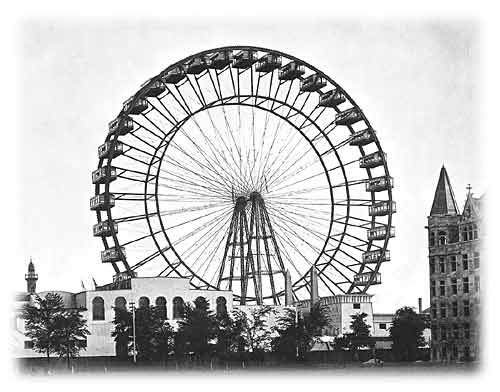
The Ferris wheel may be one of the greatest inventions of all time. It turned 100 years old in 1993.George Washington Ferris, a civil engineer from Illinois, invented the Ferris wheel in the 1890's, which was held in Chicago to commemorate the 400th anniversary of Columbus's landing in America. The Birth of the Ferris wheel: In 1893, the world turned its attention to the American city of Chicago, where that year’s World Fair was being held. Besides being only the third city in the United States to host the exposition, after the 1876 fair in Philadelphia and the 1884 fain in New Orleans, it also marked an important anniversary for the New World. In honor of Christopher Columbus’s landing in the Americas four hundred years earlier, the 1893 Fair was officially known as the World’s Fair: Columbian Exposition. The Chicago Fair's organizers wanted something that would rival the Eiffel Tower. Gustave Eiffel had built the tower for the Paris World’s fair of 1889, which honored the 100th anniversary of the French Revolution.
The problems George faced are the same many observation wheel designers face today: how to build a wheel larger than any previously built, how to get permission to build at a desired location, how to finance such a gigantic undertaking, etc. George actually wanted to build a 300 foot wheel but it was decided 300 feet would not be much better than 250 so the plans were scaled down. Once complete, the Chicago Ferris wheel would be a marvel of modern engineering and steel forging. It was considered an engineering wonder: two 140 -foot steel towers supported the wheel; they were connected by a 45-foot axle, the largest single piece of forged steel ever made up until that time. The wheel section had a diameter of 250 feet and a circumference of 825 feet. Two 1000-horsepower reversible engines powered the ride. Thirty-six wooden cars held up to sixty riders each. The ride cost fifty cents and made $726,805.50 during the World's Fair. The total Cost of the wheel was$300,000.00. Mr. Ferris' invention was and still is the largest wheel ever built. It weighed 1,300 tons (that's about how much a herd of 2,000 dairy cows would weigh!). The Ferris wheel stood 25 stories high and held over 1,400 passengers. From the top of the ride, passengers could see 50 miles. It took 20 minutes for the enormous wheel to make one complete turn. After the Chicago World's Fair, the Ferris wheel was taken to the 1904 St. Louis Exposition.
After the 1893 Fair, the wheel was relocated to another area of Chicago, where it remained until it was once again disassembled and shipped to St. Louis, MO so it could thrill visitors to the 1904 World’s Fair. Once this ended, the wheel was scrapped, but not before the device could form a lasting legacy in the realm of fairs, carnivals and city attractions. In 1895, the Chicago Wheel’s 264 feet height was surpassed by the newly constructed 308 feet tall Great Wheel in London, England, which itself was soon dwarfed by the 328 foot Grande Roué in Paris. The race for Ferris wheel supremacy was on!
The modern Ferris wheel.
When George Gale Ferris built his first wheel he probably never dreamed of the trend he was starting. However, his wheel was huge, and certainly not very portable. It took The Eli Bridge Company to develop a practical, portable wheel. Though the Ferris wheel has maintained a prominent place in its country of origin, in more recent years it has been European and Asian cities that have taken the lead in creating bigger and more spectacular observation wheels. Currently, the world’s two largest wheels are the 525 foot tall Star of Nanchang in Nanchang, China, and the 541 feet tall Singapore Flyer in Singapore. However, perhaps the most spectacular observation wheel currently in operation is the 443 feet tall London Eye, which sits on the banks of the River Thames in the city of London, England. Though not everyone is overly thrilled with the presence of the London Eye amidst the classic, subdued architecture of old London town, the wheel attracts more than 3.5 million visitors annually and is the most popular premium tourist attraction in all of the United Kingdom.
Thanks to the popularity of the original Chicago Wheel, carnivals and other travelling shows were quick to take advantage of smaller wheels that could be quickly disassembled and transported on trailers. These have been a staple of local fairs and carnivals around the world for over a century and will likely continue to hold a place for many years to come. However, they are no longer the mini versions of observation wheels they used to be. The current record for a transportable Ferris wheel is 217 Ronald Bussink wheel.
Over the years, the classic Ferris wheel with its single-wheel, round design with hanging baskets has been joined by more innovative designs. Among the most spectacular are the eccentric wheels. These wheels act like a combination roller coaster/Ferris Wheel as the individual passenger baskets slide along the rails of the wheel for a more dynamic ride.
Looking Forward to Tomorrow.
As we continue into the 21st Century, we can expect to see the classic Ferris or observation wheel maintain its place in fairs and amusement parks around the world. But we will likely see more innovative and grander designs erected in cities around the world. New York City, Orlando, Florida and Las Vegas, Nevada are all planning spectacular rides hoping to restore the grandeur of the Ferris wheel to its home nation. But the competition is still as cities such as Dubai, United Arab Emirates, Kolkata, India and Shanghai, China have their own projects in the works. What the future holds for the humble observation wheel no one can say for sure, but one must speculate that somewhere in the world today, there is someone dreaming of the first observation wheel on the Moon, or perhaps on Mars.


留言